Stone Pillars and Reclaimed Wrought Iron Gates
Stone Pillars Prior to Gate Installation
Stone Pillars Prior to Gate Installation
Stone Pillars Prior to Gate Installation

Newly constructed stone pillars installed and carefully aligned in preparation for the wrought iron gate installation. Foundations were set out with precision to ensure accurate positioning, structural stability and a secure, long-lasting fit.
Stone Pillar Detail
Stone Pillars Prior to Gate Installation
Stone Pillars Prior to Gate Installation

Close-up of a newly constructed stone pillar, carefully crafted with traditional moulded detailing. Precision workmanship and quality materials ensure a durable, well-proportioned feature ready to support the wrought iron gate installation.
Wrought Iron Gate Installation
Stone Pillars Prior to Gate Installation

The wrought iron gate being carefully positioned between newly constructed stone pillars. Specialist lifting equipment ensured accurate alignment and safe installation, preparing the entrance for final fixing, adjustment and finishing details.
Reclaimed Gates & Pillar

The wrought iron gates were carefully reclaimed and fully restored, preserving their original character and detailing. New stone pillars were precisely positioned to accommodate the gates’ dimensions, ensuring accurate alignment, structural stability and a seamless installation.
Reclaimed Gates Installed
Restored Gates in Position

The reclaimed wrought iron gates were fully restored and carefully rehung between newly constructed stone pillars. The pillars were accurately set out to suit the gates’ original dimensions, ensuring precise alignment, smooth operation and a secure, lasting installation.
Restored Gates in Position
Restored Gates in Position

The reclaimed wrought iron gates have been fully restored and installed between the newly constructed stone pillars. The pillars were precisely positioned to accommodate the original gate width, ensuring correct alignment, secure fixing, and smooth operation while enhancing the character of the entrance.
Bringing New Life to Old Buildings: The Cast Iron Railing Company's Restoration Gallery



Drybridge House, Monmouth Gates and Railings Restoration
Preparation Works for Railing Restoration
Careful Cutting of Pillar for Railing Removal
Careful Cutting of Pillar for Railing Removal

Preparation works began for railing restoration. The gates were carefully dismantled and removed for off-site specialist repair and refinishing, with surrounding areas opened to allow safe removal and accurate reinstatement.
Careful Cutting of Pillar for Railing Removal
Careful Cutting of Pillar for Railing Removal
Careful Cutting of Pillar for Railing Removal
Historic railings carefully cut free from surrounding stonework to allow removal for off-site restoration. The process ensured minimal disturbance to the masonry while preserving original ironwork for specialist conservation treatment.
Brick Restoration and Repair
Careful Cutting of Pillar for Railing Removal
Brick Restoration and Repair
The existing pillar was carefully cut and partially dismantled to allow the safe removal of the railings. Works were undertaken in a controlled manner to minimise disturbance and enable accurate reconstruction.
Lifting Operations
Railing Reinstatement
Brick Restoration and Repair
Specialist lifting equipment was utilised to carefully remove and transport the railings and associated components from site. All works were carried out under controlled conditions to ensure safe handling and prevent damage prior to restoration.
Railing Reinstatement
Railing Reinstatement
Railing Reinstatement
The restored railings were carefully repositioned and securely fixed into the existing stonework.
Gates Reinstalled
Railing Reinstatement
Railing Reinstatement
The restored wrought iron gates were carefully rehung between the existing stone piers. Alignment and levels were checked to ensure smooth operation, with fixings securely set and surrounding areas prepared for final making good.
Drybridge House Railings and Gate


Cast Iron Railing Restoration
During Installation
Decorative Casting Detail
The castings are one of six traditional patterns we hold, distinctive to North Bristol. This design was selected for the railing installation to complement the property and remain in keeping with the character of the area.
Decorative Casting Detail
Decorative Casting Detail
The selected North Bristol casting pattern features traditional ornamental detailing, including finial and scroll elements. Each casting was carefully prepared, primed, and finished before secure fixing to the stonework, ensuring durability and a high-quality finish.
Railings in Progress
The traditional North Bristol cast iron railings were installed onto the newly constructed stone wall.
High-Build Protective Coating
Railing Installation Prior to Final Topcoat
Close-up showing the quality of the protective undercoats applied to ensure long-term durability. This image highlights the high-build intermediate coat, providing a robust base prior to application of the final topcoat.
Railing Installation Prior to Final Topcoat
Railing Installation Prior to Final Topcoat
Railing Installation Prior to Final Topcoat
The completed railing installation shown before application of the final topcoat. At this stage, the high-build protective system is in place, ensuring durability and long-term performance, with the finishing coat to follow for the completed appearance.
Completed Installation with Final Topcoat
Railing Installation Prior to Final Topcoat
Railing Installation Prior to Final Topcoat
The finished railing installation following application of the final topcoat. The deep finish enhances the detailing of the traditional castings while providing long-term protection, complementing the natural stone wall and maintaining the character of the surrounding properties.
Complex Cast Iron Railing Restoration Case Study
Investigative Restoration of Historic Cast Iron Railings
Investigative Restoration of Historic Cast Iron Railings
Investigative Restoration of Historic Cast Iron Railings
This was a particularly challenging restoration project, as the original method of assembly was unknown. Over time, water ingress had caused the decorative castings to crack and detach from the wrought iron uprights.
Evidence of Water Ingress and Corrosion
Investigative Restoration of Historic Cast Iron Railings
Investigative Restoration of Historic Cast Iron Railings
Close-up detail showing the extent of corrosion caused by prolonged water ingress. Moisture trapped within the joint between the decorative cast iron finial and the wrought iron upright led to rust expansion, ultimately cracking the casting and forcing it away from its original fixing.
This highlights the importance of correct assembly, sealing, and protective coatings in ensuring the long-term integrity of traditional ironwork.
Extent of Loss Prior to Restoration
Investigative Restoration of Historic Cast Iron Railings
Extent of Loss Prior to Restoration
This image highlights the number of decorative casting elements that had been lost as a result of prolonged corrosion before the railings were removed for restoration. The deterioration had significantly compromised both the structural integrity and the original appearance of the ironwork, making careful dismantling and sympathetic reinstatement essential to the project.
Railings Prior to Restoration
Detailed Condition Prior to Restoration
Extent of Loss Prior to Restoration
A distance view of the cast iron railings before restoration works commenced. The image shows the condition of the frontage at the outset, prior to removal, repair, and reinstatement of the decorative ironwork elements.
Detailed Condition Prior to Restoration
Detailed Condition Prior to Restoration
Detailed Condition Prior to Restoration
Close-up view of the railings prior to restoration, clearly showing areas of corrosion and failed cast elements. Several decorative components had fractured or detached due to prolonged water ingress and rust expansion within the joints.
This condition required careful dismantling, assessment, and replication of missing details to ensure an accurate and sympathetic restoration.
Railings During Removal for Restoration
Detailed Condition Prior to Restoration
Detailed Condition Prior to Restoration
The railings shown during careful removal from site prior to restoration. Sections were dismantled methodically to prevent further damage to the surviving cast and wrought iron elements.
This stage allowed for full assessment of corrosion, safe separation of components, and preparation for off-site repair, replication of lost castings, and application of a comprehensive protective coating system.
Restoration Masterpieces: The Cast Iron Railing Company's Before and After Gallery


Expert Railing Restoration and Repair
Decorative Cast Iron Detail – Prior to Restoration
Close-up of the original cast iron panel before restoration, highlighting the intricate circular motif and surrounding detailing. Surface wear, aged paint layers, and minor corrosion are visible, reflecting the effects of time and exposure.
Gate Finial Detail – Prior to Restoration
Close-up of a decorative cast iron finial before restoration. Extensive paint failure and surface corrosion are clearly visible.
The deterioration illustrates how prolonged exposure and moisture ingress can break down protective coatings, leading to rust formation and gradual loss of surface detail. Careful preparation and a comprehensive protective system were required to arrest corrosion and restore the original character of the piece.
Section of Railings – Pre-Restoration Condition
Angled view of the original cast iron railing section prior to restoration. The image shows widespread paint breakdown, surface corrosion, and early signs of joint failure, particularly around decorative elements and connection points.
Weather exposure and moisture retention over time had compromised the protective coatings, allowing rust to develop beneath the paint layers. This condition required full removal, careful dismantling, and comprehensive restoration to preserve the historic detailing and structural integrity of the ironwork.
Decorative Cast Iron Detail – After Restoration
Decorative Cast Iron Detail – After Restoration
Close-up of the restored cast iron panel following repair, preparation, and application of the full protective coating system. The intricate circular motif and surrounding detailing are now clearly defined, with a smooth, even finish enhancing the depth of the original design.
The comprehensive treatment ensures long-term protection while preserving the character and craftsmanship of the historic ironwork.
Gate Section – Final Topcoat Applied
Decorative Cast Iron Detail – After Restoration
Gate Section – Final Topcoat Applied
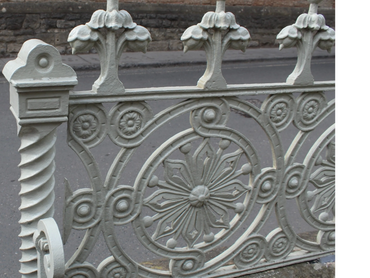
The gate shown here following application of the final topcoat colour, which enhances and highlights the intricate cast iron pattern and crisp detailing throughout the design.
Interestingly, this is the same casting pattern used in the Horniman’s cast iron conservatory in London, highlighting the heritage and significance of the design.
Preserving Historic Cast Iron
Decorative Cast Iron Detail – After Restoration
Gate Section – Final Topcoat Applied
Restoring historic cast iron work such as this is vital in preserving the craftsmanship, character, and architectural heritage of our built environment. These pieces are not only functional elements but also examples of traditional design and manufacturing techniques that are rarely replicated today.
By carefully conserving and reinstating them, we ensure that future generations can continue to appreciate their detail, quality, and historical significance within the streetscape.
Restoration Masterpieces: The Cast Iron Railing Company's Before and After Gallery


Restoring Historic Cast Iron in Cheddar, Somerset

Case Study: Recasting and Forging Traditional Iron Railings
Faithful Restoration of Period Ironwork
Railings Mid-Restoration: Careful Dismantling and Reassembly
Railings Mid-Restoration: Careful Dismantling and Reassembly
The project commenced with a detailed examination of the surviving iron stubs embedded within the stone boundary wall, which provided valuable physical evidence of the original railing configuration. This was supplemented by a historic photograph retained by the owner, clearly illustrating the original railings and gate design.
Railings Mid-Restoration: Careful Dismantling and Reassembly
Railings Mid-Restoration: Careful Dismantling and Reassembly
Railings Mid-Restoration: Careful Dismantling and Reassembly
Drawing upon this documentary and physical evidence, new cast iron posts and railings were accurately recast to replicate the historic pattern. The accompanying gate was traditionally forged in genuine wrought iron supplied by Topp & Co., ensuring material authenticity and adherence to established craft practices.
Setting and Context Prior to Reinstatement
Railings Mid-Restoration: Careful Dismantling and Reassembly
Completed Reinstatement of Historic Railings
The boundary wall and entrance prior to reinstatement of the historic railings and gate, illustrating the loss of the original ironwork and its impact on the architectural character of the streetscape.
Completed Reinstatement of Historic Railings
Curved Section Reinstated to Original Profile
Completed Reinstatement of Historic Railings
The reinstated cast iron railings following conservation and installation, restoring definition, craftsmanship, and historic character to the boundary wall and wider streetscape.
Curved Section Reinstated to Original Profile
Curved Section Reinstated to Original Profile
Curved Section Reinstated to Original Profile
The newly installed cast iron railings follow the original curved alignment of the boundary wall, reinstating the intended architectural rhythm and enhancing the historic streetscape.
Newly Cast Posts Prepared for Installation
Curved Section Reinstated to Original Profile
Curved Section Reinstated to Original Profile
Individually cast iron posts finished in a traditional black protective coating, prepared for installation as part of the faithful reinstatement of the historic railing scheme.
Reconstructed Wrought Iron Gate – Interpreted from Historic Drawing

This drawing illustrates the reconstructed gate design, informed by historic information retained by the property owner. The original gate featured taller vertical bars; however, the proportions were moderated to avoid an overly imposing appearance. The revised design retains the character of the historic gate while achieving a more balanced relationship with the surrounding stonework and railings

The decorative scroll element of the gate was traditionally hand-forged from genuine wrought iron supplied by Topp & Co. Heated in the forge and shaped under hammer, the iron was carefully drawn and curled to form the scroll, reflecting established blacksmithing techniques. Such craftsmanship ensures the detail remains faithful to historic wrought iron practice and contributes to the authentic cha

The completed wrought iron gate installed between the existing stone piers, carefully fabricated in accordance with the measured drawing and surviving historical evidence. Hand-forged scrolls and traditional vertical bars reflect the character of the original design, while the slightly reduced bar height ensures the gate sits comfortably within its setting, preserving both the architectural balanc
Cast Iron Railing Restoration
Cast Iron Stair Railing Restoration
New cast iron railing installed to the entrance steps, designed to complement the existing stonework and architectural detailing. The decorative cast panels and traditional finials reflect historic railing patterns commonly associated with nineteenth-century domestic architecture, providing both protection and a refined architectural accent to the stair.
Detail of Cast Iron Stair Railing
Close detail of the cast iron stair railing, showing the decorative cast panels, traditional ball finial and hand-forged scroll termination. The railing was designed to complement the existing stone stair and architectural detailing, drawing upon historic nineteenth-century patterns commonly used in domestic entrance railings.
Restored Cast Iron Stair Railings
Restored Cast Iron Stair Railings
View of the completed cast iron stair railings installed at the entrance steps. The design incorporates traditional cast decorative panels, ball finials and hand-forged scroll terminations, carefully composed to complement the existing stone stair and classical architectural detailing of the house. The restored ironwork reinstates an important historic feature, enhancing both the character and setting of the entrance.
Traditional Fixing Detail
Decorative Cast Iron Boundary Railings
Restored Cast Iron Stair Railings
Detail showing the cast iron railing post set into the original stone coping and secured using traditional lead fixing. This method provides durability while reflecting historic installation techniques commonly used in nineteenth-century ironwork.
Completed Entrance Gates
Decorative Cast Iron Boundary Railings
Decorative Cast Iron Boundary Railings
The completed wrought iron gates installed at the base of the entrance steps. Forged in a restrained traditional style, the design complements the historic character of the house while providing a refined and welcoming approach to the property.
Decorative Cast Iron Boundary Railings
Decorative Cast Iron Boundary Railings
Decorative Cast Iron Boundary Railings
Decorative cast iron railings installed along the stone boundary wall. Each panel incorporates traditional cast ornament and finial details, carefully spaced to create a rhythmic composition that complements the historic masonry and reinforces the architectural character of the setting.
Balcony Railings with Timber Posts Restoration
Balcony Railing Condition Prior to Restoration
Balcony Railing Condition Prior to Restoration
Balcony Railing Condition Prior to Restoration
Prior to restoration the wrought iron balcony railing showed signs of long-term neglect, including heavy paint build-up and distortion of the scrollwork. Movement and gradual dropping of the supporting stone slab had placed stress on the ironwork, resulting in fractures and localised breaks to the decorative elements.
Fractured Decorative Ironwork
Balcony Railing Condition Prior to Restoration
Balcony Railing Condition Prior to Restoration
Detail of the balcony railing prior to restoration showing fractures and distortion within the lower decorative element. Structural movement caused by the gradual dropping of the supporting stone slab had placed stress on the ironwork, resulting in breaks within the ornamental section.
Railing Post Base Condition
Balcony Railing Condition Prior to Restoration
Fractured cast iron scroll following structural movement
Detail of a cast iron post base set into the stone slab. The original lead fixing had deteriorated, allowing moisture ingress and biological growth around the base of the post, contributing to corrosion and movement within the fixing.
Fractured cast iron scroll following structural movement
Fractured cast iron scroll following structural movement
Fractured cast iron scroll following structural movement
Grit blasting removed paint and corrosion, exposing the fracture in the cast iron scroll caused by the downward movement of the balcony’s stone slab. Cleaning the surface allows the repair to be accurately assessed and carried out.
Fractured scroll connection detail
Fractured cast iron scroll following structural movement
Wrought Iron Bracket After Careful Restoration
Prior to conservation, surface preparation revealed severe wastage in the wrought iron at the fixing point, with clear deterioration evident around the fixing plate.
Wrought Iron Bracket After Careful Restoration
Fractured cast iron scroll following structural movement
Wrought Iron Bracket After Careful Restoration
A damaged handrail fixing restored with a precision weld and reinforced mounting plate, ensuring strength, safety, and long-lasting support.
Integrated Restoration of Historic Stone, Castings, and Ironwork

Reinstatement of Traditional Lead Joint
The stone slabs were rejoined using a traditional poured lead joint, reinstating the original method of construction and ensuring the repair remains sympathetic to the historic fabric.

Fractured Historic Casting
The casting prior to conservation, with a visible break through the section. Specialist repair techniques were required to restore structural integrity while retaining the original fabric.
Restoration of a Historic Cast Iron Panel
Expert welding work restores the structural integrity of this historic cast iron panel, reinforcing the compromised section while preserving its original craftsmanship and architectural heritage.
Conservation of Early 19th Century Ironwork and Stone
High‑Build Coating Applied to Restored Cast Iron
Completed Restoration of Historic Cast Iron and Stone Balcony Slabs
Completed Restoration of Historic Cast Iron and Stone Balcony Slabs

A two-pack epoxy paint system is applied to the restored cast iron panel, creating a smooth, protective base that enhances the detail of the original workmanship.
Completed Restoration of Historic Cast Iron and Stone Balcony Slabs
Completed Restoration of Historic Cast Iron and Stone Balcony Slabs
Completed Restoration of Historic Cast Iron and Stone Balcony Slabs
The restored cast iron railing panels and historic stone slab are brought back to their original elegance through meticulous conservation. Each section of ironwork has been carefully repaired and refinished. Together, they present a refined and faithful restoration that respects the character and heritage of the property.
Restoration of Regency Balcony - Tunbridge Wells
Elegant Restoration of Regency Cast Iron Balcony
This Regency cast iron balcony has been meticulously restored to its former elegance. The intricate iron panels were repaired and refinished to highlight their original detailing, while the later timber columns—showing signs of rot—were expertly conserved and refinished to ensure lasting stability and visual harmony.

Forming Lead Details with Precision Bronze Dies
A finely cast bronze die is used to shape the lead detail, ensuring a crisp appearance and a perfect angle for drainage. This traditional technique combines craftsmanship with durability, creating a refined and functional finish that protects and complements the surrounding historic fabric.
Restored Cast Iron Post and Wrought Iron Handrail
A newly restored cast iron post and wrought iron handrail are securely fixed to the conserved timber columns, using bronze screws and washers, creating a refined and enduring connection between traditional materials. The restoration showcases the craftsmanship and attention to detail that preserves both the strength and the historical integrity of